




Panel by Panel Toward Cleaner Shipping: Modular SCR Systems in Practice
Requirements for emission reduction in the maritime industry continue to increase. At the same time, many operators face a practical challenge: the ship has already been built.
While SCR (Selective Catalytic Reduction) systems can be integrated into the vessel design at an early stage during newbuilding projects, retrofitting existing ships is often far more demanding. Limited installation space, restricted access routes, and short maintenance windows can turn conventional retrofit concepts into both a technical and economic challenge.
This is where modular SCR systems provide a significant advantage. They enable the integration of high-performance exhaust gas treatment solutions even in areas where conventional large-scale components would require extensive modifications or cannot be installed at all.
Key Factors for Planning a Panel-Based SCR Retrofit
Before selecting a panel-based SCR design for a retrofit project, several technical and operational factors should be evaluated. These include the available installation space, the routing of the exhaust gas system, engine characteristics, and the vessel’s operating profile. Project planning should also consider maintenance requirements, accessibility for future service work, and available transport and access routes during installation. Assessing these factors early helps determine the most suitable SCR configuration and supports efficient retrofit execution.
Why Conventional SCR Retrofit Projects Are Often Challenging
Installation Space, Accessibility, and Operational Downtime
Every retrofit project starts with a fundamental question: How can the SCR system be transported and integrated into the available onboard space?
Many existing vessels were never designed with future SCR retrofits in mind. Large reactor housings or mixers often cannot be transported through existing access points. In practice, this frequently results in additional structural modifications, extensive dismantling work, or prolonged shipyard stays.
In addition, available space varies significantly from vessel to vessel. Existing piping systems, machinery, maintenance routes, and exhaust gas infrastructure further limit the installation space available.
Why Cruise Ships Are Particularly Affected
For cruise ship operators, downtime can be especially costly. Every additional day spent in the shipyard potentially means lost operating time.
At the same time, many vessels feature complex engine room layouts and highly restricted access conditions. As a result, retrofit projects often need to be planned so that technical modifications can be completed within short maintenance windows.
The challenge is not simply to design an SCR system. The key is developing a solution that can realistically be integrated under actual onboard conditions.
Modular SCR Retrofits and IMO Tier III Compliance
The growing demand for IMO Tier III compliance is one of the main drivers behind marine SCR retrofit projects. IMO Tier III regulations set strict limits for nitrogen oxide (NOx) emissions from ships operating in designated Emission Control Areas (ECAs). Selective Catalytic Reduction (SCR) systems help vessel operators meet these requirements by converting nitrogen oxides into harmless nitrogen and water through a catalytic process.
For existing vessels, however, integrating an SCR system can be challenging due to limited space, structural constraints, and operational schedules. This is where panel-based SCR design offers a practical advantage. By dividing the SCR reactor into transportable modules, installation can be adapted to the vessel’s available space and maintenance planning, helping shipowners implement NOx reduction technology while supporting compliance with current environmental regulations.
What Is a Modular SCR System?
Built in Sections Instead of Large Components
A modular SCR system follows a different approach than conventional designs. Instead of large preassembled housings, the system consists of multiple individual segments or panels.
These components are designed to be transported through existing access routes aboard the vessel. Final assembly then takes place directly at the intended installation location.
This approach provides significantly greater flexibility for retrofit projects, especially on vessels with limited installation space.
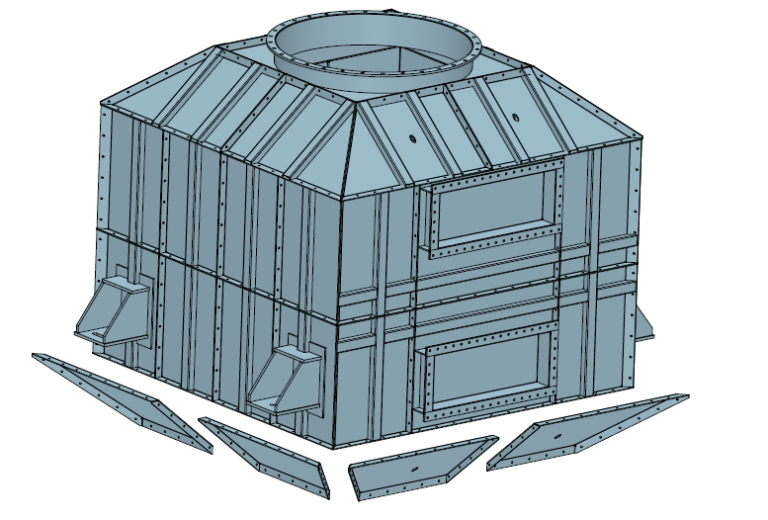
Assembly Under Real Onboard Conditions
The modular design allows reactors and other system components to be assembled step by step onboard.
This opens new possibilities for projects where conventional SCR systems would be difficult or impossible to integrate due to their dimensions. At the same time, existing structures and access routes can often be utilized without requiring extensive modifications to the vessel.
Panel by Panel: How Integration Works
Transport Through Existing Ship Access Points
One of the key advantages of panel-based construction is logistics.
Instead of bringing complete large-scale components onboard, individual modules are transported separately. This significantly simplifies handling and reduces transport and installation effort.
Especially within existing fleets, this can be a decisive factor in determining the technical feasibility of a retrofit project.
Installation Without Major Structural Modifications
Many retrofit projects raise the question of whether large openings must be cut into the ship’s structure.
Thanks to the modular design, this effort can often be reduced. Individual components are assembled onsite and adapted to the existing conditions.
This does not mean retrofit projects automatically become simple. Technical planning remains complex. However, panel-based construction provides additional flexibility for integration under challenging conditions.
Installation During Short Maintenance Windows
Many operators only have limited time available for technical modifications.
A modular SCR system can help align installation activities more effectively with available maintenance periods. As a result, retrofit projects can often be integrated more efficiently into existing service schedules.
Benefits of Modular SCR Systems for Fleet Operators
Reduced Downtime
Downtime is one of the most important economic considerations in any retrofit project.
When installation and integration can be planned more effectively, shipyard stays and operational interruptions can potentially be reduced. For operators, this means greater planning reliability and improved vessel availability.
Flexible Retrofit Solutions for Existing Vessels
Not every fleet consists of identical ships. Different engines, machinery arrangements, and operating profiles require tailored solutions.
Modular SCR systems provide the flexibility needed to address these varying requirements.
Adaptation to Available Installation Space
Available installation space is often the defining factor in retrofit projects.
For this reason, system engineering does not begin with the product itself but with the actual onboard conditions. Exhaust gas routing, accessibility, maintenance requirements, and operational profiles must all be considered together to develop a technically sound solution.
Engineering as the Key Success Factor
Why Standard Solutions Are Often Not Enough
There is rarely a universal solution in marine retrofit projects.
Every vessel has unique requirements related to installation space, engine configuration, operational patterns, and maintenance strategies. As a result, standardized concepts frequently reach their limits.
Successful SCR retrofits are based on a detailed technical assessment of the existing situation. Only then can the most suitable system architecture be determined for the specific vessel.
More Than 30 Years of SCR Experience from H+H
H+H Engineering & Service has been developing SCR solutions for maritime and stationary applications for more than 30 years.
The focus is not on a single product, but on the technical feasibility of the overall solution. From analyzing existing installation conditions and developing customized system designs to supporting implementation, H+H works closely with operators, shipyards, and engineering partners to provide practical SCR expertise.
Particularly in complex retrofit projects, it becomes clear that successful emission reduction depends not only on the technology itself but also on the ability to integrate it reliably under real-world operating conditions.
Conclusion
Limited installation space, restricted access routes, and economic time pressure are among the greatest challenges in SCR retrofit projects within the maritime industry.
A modular SCR system offers a practical solution. By using individual panels instead of large prefabricated units, components can be transported and integrated even under challenging installation conditions. This can help reduce the need for extensive structural modifications and make it easier to align retrofit projects with existing maintenance schedules.
However, a successful retrofit always starts with a thorough technical assessment. Effective retrofit solutions are not built on standard products, but on engineering that is fully tailored to the specific conditions of each vessel.
FAQ
What Defines a Modular SCR System?
Which Ships Are Suitable for a Modular SCR Retrofit?
Can an SCR System Be Retrofitted Without a Shipyard Stay?
This depends on the specific project requirements. Modular systems can help fit installation work more effectively into existing maintenance windows, but a detailed technical evaluation is always required.
What Are the Advantages of a Modular SCR System in Limited Spaces?
How Is an SCR Retrofit Evaluated Technically?
Technical Consultation for SCR Retrofit Projects
Are you planning a retrofit project or evaluating whether a modular SCR system is suitable for your fleet?
Talk to our team about your application. Together, we assess the technical framework and develop a solution that fits your vessel, operational profile, and emission reduction goals.
Engineering first, system design second. Because every successful retrofit begins with a clear understanding of what is technically achievable onboard.